How to Read Supplement Facts
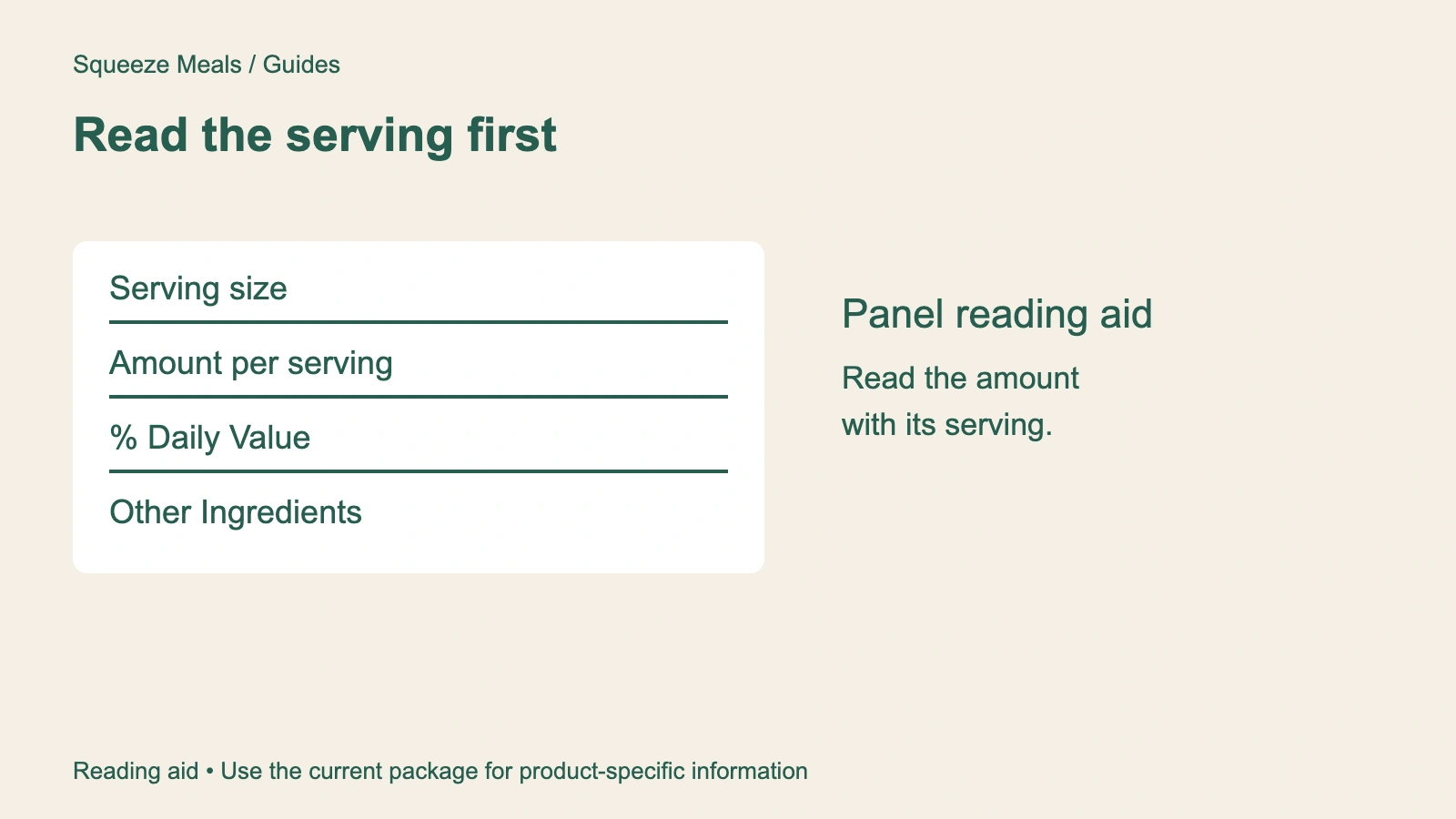
The amount on a Supplement Facts panel usually describes a serving, which can contain several capsules or tablets. Find that serving size before reading the ingredient rows. Then check servings per container and the separate Other Ingredients list.
Start with the serving
Find the serving size first. A powder might list one scoop while a capsule product lists two capsules, so comparing a scoop with one capsule without adjusting the serving would be misleading.
FDA requires the Supplement Facts panel to identify the serving size and list dietary ingredients with their amounts per serving. The manufacturer sets the labeled serving within the applicable rules. That serving is a unit for reading the panel, not a personal recommendation from FDA.
Servings per container answers a different question: how many labeled servings the package contains. Use it for package duration and cost-per-serving math. If a bottle costs $36 and contains 30 servings, the listed cost is $1.20 per serving. A lower bottle price can still mean a higher cost per serving.
When directions describe more than one use pattern, write down the exact pattern you are comparing. Do not silently convert the largest amount on the package into a plan for yourself.
Read amounts and units carefully
The amount column may use grams (g), milligrams (mg), or micrograms (mcg). These units are not interchangeable. One milligram equals 1,000 micrograms, and one gram equals 1,000 milligrams. Keep the unit attached to every number in your notes.
Use Supplement Facts to check the declared dietary ingredients and amounts behind a front-panel claim. FDA also requires an Other Ingredients list for ingredients outside that panel.
For a proprietary blend, the panel can show the total weight of the blend without giving the amount of every ingredient inside it. You can confirm which ingredients are present, but you may not have enough information to compare each one by amount. Treat missing quantities as missing comparison data.
What % Daily Value means
Daily Value (DV) is a reference amount for a nutrient. Percent Daily Value (%DV) tells you how much one labeled serving contributes to that reference. It is calculated per serving, so doubling the serving also doubles the listed nutrient amount and its contribution to the DV.
FDA uses 5% DV or less as a general guide for a low amount and 20% DV or more for a high amount. Those markers describe the amount in a serving. They do not prove that a product is suitable for you, and they do not replace advice based on diet, health history, medications, lab work, age, pregnancy, or other individual factors.
Some dietary ingredients have no established Daily Value. A blank %DV or a symbol explaining that no DV has been established does not grade the ingredient as good, bad, strong, or weak. It means the panel does not have an FDA Daily Value to use for that percentage.
What the label can answer
A current package label can answer practical shopping questions:
- What counts as one labeled serving?
- How many labeled servings are in the package?
- Which dietary ingredients are declared?
- How much of each listed ingredient is present per serving when the amount is disclosed?
- Is a %DV provided?
- Which capsule materials, flavors, sweeteners, or other ingredients are listed?
- What do the directions and storage notes say? Which warnings and company contact details appear on the package?
The NIH Office of Dietary Supplements maintains the Dietary Supplement Label Database (DSLD), which includes label images and declared product information. It can help with research, especially when you want to inspect an older label. Formulas and packaging can change, so the package currently in your hand remains the final check.
What the label cannot answer
The label cannot determine whether a supplement will produce a result for a particular person. It cannot account for every medication, medical condition, pregnancy, planned procedure, or source of the same nutrient elsewhere in a routine.
FDA does not approve dietary supplements for safety and effectiveness before they are marketed. A lawful Supplement Facts panel is therefore different from FDA approval of the product. Marketing language on the front of the package also deserves a separate reading from the factual quantities on the back.
Certification or testing seals should be verified with the organization named on the seal. Check what the program covers and whether the exact product appears in its directory. A seal should not be stretched into a claim about effectiveness unless the program itself makes and supports that claim.
A side-by-side comparison checklist
Use one row per product and copy the wording from the current label.
| Compare | Product A | Product B | Why it matters |
|---|---|---|---|
| Serving size | Puts every other number on the same basis | ||
| Servings per container | Supports duration and cost-per-serving math | ||
| Ingredient form | Prevents comparison by a shortened front-label name | ||
| Amount per serving | Shows the declared quantity with its unit | ||
| % Daily Value | Gives an FDA reference where a DV exists | ||
| Blend amounts disclosed? | Identifies where direct comparison is limited | ||
| Other Ingredients | Captures capsule materials and flavoring components | ||
| Directions and warnings | Flags questions that affect use | ||
| Current price per serving | Compares package value on the same basis | ||
| Questions for a professional | Keeps personal decisions separate from label reading |
Two examples from the catalog
The Creatine - 90 Servings and Creatine - 180 Servings pages show why package count and price should be compared together. Both are listed as powders. Start with the current package serving size, confirm the amount and form of creatine per serving, then divide the current price by the labeled serving count. Check Other Ingredients before treating the two packages as equivalent.
The same method applies to Basic Nutrients 2/Day - 30 Servings and Basic Nutrients 2/Day - 60 Servings. A multivitamin panel has more rows, so nutrient overlap matters. Compare amounts and %DV against other products already in the routine rather than reading each bottle in isolation. Browse the multivitamin category or the broader supplement catalog to make a short list before opening the current labels.
Check the current listing and package before relying on an example: prices, availability and formulas can change. These are exercises in reading product information, not product recommendations.
When to ask a clinician or pharmacist
Bring the product name, a photo of the full label, the serving information, and a list of medications and other supplements. FDA advises discussing supplements with a health-care professional because some can interact with medicines, affect lab tests, or create concerns around surgery.
Ask before making the product part of your routine when:
- you take prescription or over-the-counter medication;
- you are pregnant, planning pregnancy, or breastfeeding;
- you have a medical condition or recent change in health;
- you have lab testing or surgery planned;
- the same ingredient appears in more than one product;
- the directions, unit conversion, blend amount, or warning is unclear.
Ask whether the formula overlaps with products you already take or could affect a medicine, test or procedure. Bring the complete panel so the professional can assess the labeled amount in your circumstances.
Open the supplement catalog and compare two current labels side by side. Copy the serving size, amount per serving, %DV, Other Ingredients, and current price per serving before deciding what belongs on your shortlist.
Sources
Sources checked September 19, 2026:
This guide is educational and does not replace current product labels or advice from a qualified health-care professional.