Reading a Probiotic Strain Name
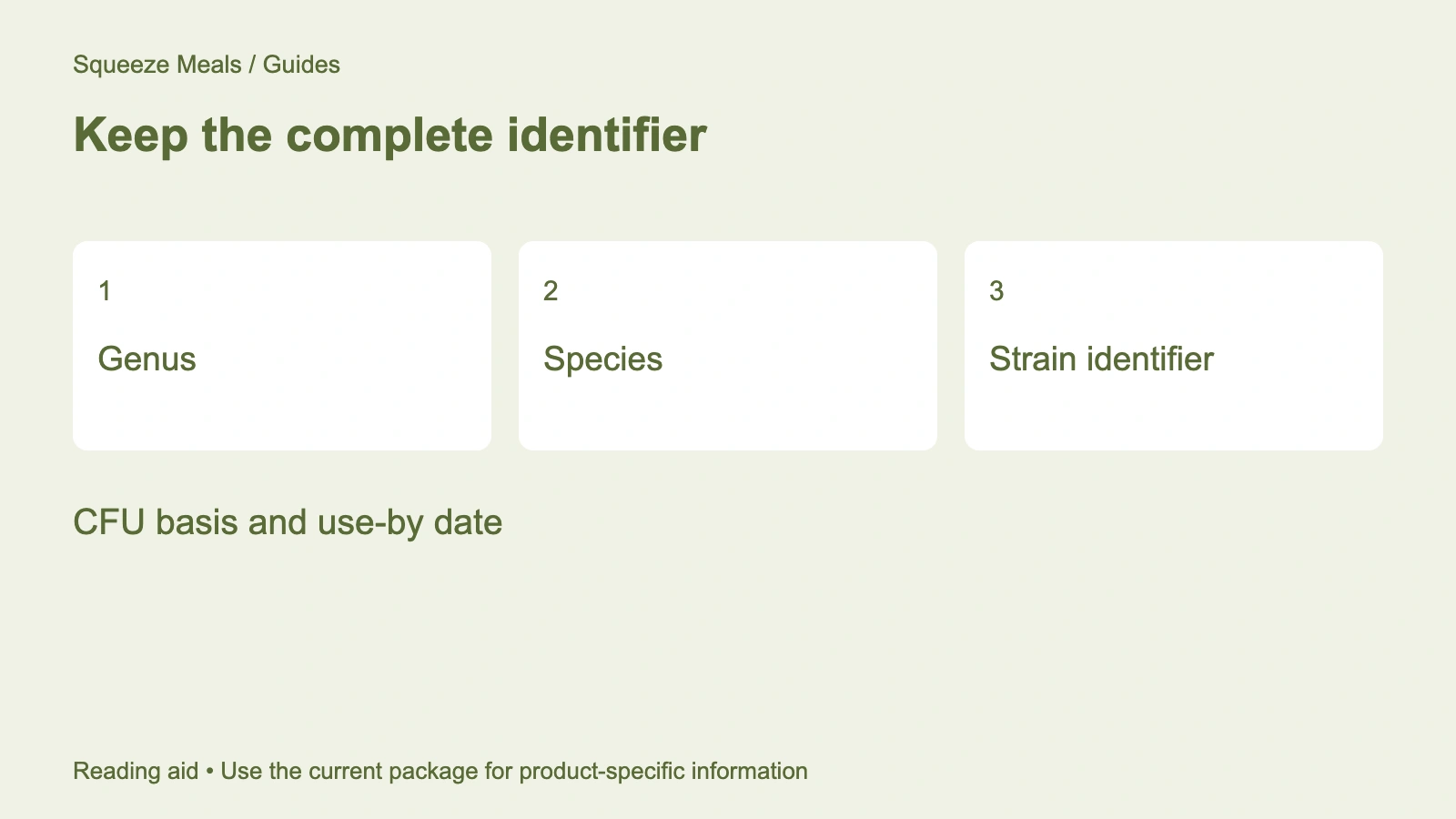
Copy a probiotic's name all the way to its strain identifier, if one is given. Stopping at the species can leave you comparing different preparations. Then check whether the CFU statement refers to manufacture or the use-by date.
Copy the name all the way to the strain
A familiar organism name can look reassuring while leaving a key detail unresolved. Keep the strain code. Its letters and numbers can distinguish products that would otherwise appear similar, so copy them alongside the complete organism name.
NIH ODS explains that the microorganisms present and their amounts matter when assessing a probiotic. Results for a particular strain and use should not be assumed to apply to any bottle bearing a related name. NIH ODS probiotics fact sheet
Keep a photograph of the panel with your notes. If a seller's short description omits a strain identifier, ask for the current label rather than borrowing the identifier from another website or an older version.
Read what the CFU number refers to
CFU means colony-forming units, a measure used to describe viable microorganisms. NIH ODS notes that CFUs can decline over time, so a count stated at manufacture answers a different question from a count stated through expiration.
Look for the qualifying words. Copying only the largest number loses the date basis, and it can make a comparison look more precise than the available label supports. If a multi-strain formula gives one combined CFU number, record it as a total. Do not divide it evenly among the listed strains.
Build a small comparison table
| Label field | What to write down | Question if unclear |
|---|---|---|
| Organism identity | Full name and strain code | Is the strain identifier available? |
| CFUs | Count and full serving size | Is this per capsule or per serving? |
| Count timing | Manufacture, expiration, or other wording | What count is stated through shelf life? |
| Blend | Individual counts if disclosed | Is the total all that is available? |
| Storage | Exact temperature and handling directions | Do conditions change after opening? |
| Package | Use-by date and seal condition | Can I use this within its stated life? |
A missing field should stay visible in your notes. Write "not disclosed" instead of assuming that a large count compensates for an unidentified strain.
Storage is a product-specific instruction
Some packages specify refrigeration. Others have different storage directions. Follow the actual instructions for the product you are considering, and ask the manufacturer about shipping or storage concerns that the label does not resolve.
A refrigerator in an illustration is not a direction to refrigerate every probiotic. Before buying a large package, check whether its stated storage requirements fit your home and travel plans. Keep the original container so that the use-by date and handling information remain available.
Applying this to a catalog candidate
FloraMend Prime Probiotic is a Squeeze Meals catalog starting point. The name alone does not establish its strains, CFU count, or storage conditions. Obtain the current panel before making those entries in your comparison sheet.
Use the Supplement Facts guide for general serving-panel questions. For probiotic selection, keep your specific purpose attached to the comparison, rather than adding together strains and treating the largest total as the goal.
Know when to ask a professional
NIH ODS advises particular caution about probiotic safety in people who are seriously ill or have weakened immune systems. If that applies to you, resolve suitability with your clinician before buying. Bring your medicines and full product label to the discussion.
This article does not select a strain for a disease, recommend a CFU target, or prescribe a schedule. For a child, pregnancy, nursing, or a medical condition, obtain individualized guidance instead of applying an adult product comparison mechanically.
For FloraMend Prime Probiotic, look for the complete organism names and the basis of the CFU statement. Keep the use-by and storage wording with that record.
Sources
Checked September 29, 2026. Recheck the current product label before purchase.
- NIH ODS: Probiotics — Fact Sheet for Consumers (NIH Office of Dietary Supplements).
- NIH Office of Dietary Supplements: What You Need to Know for general supplement safety and professional consultation.
This guide is educational and does not replace current product labels or advice from a qualified health-care professional.