Protein Grams vs. Scoop Weight
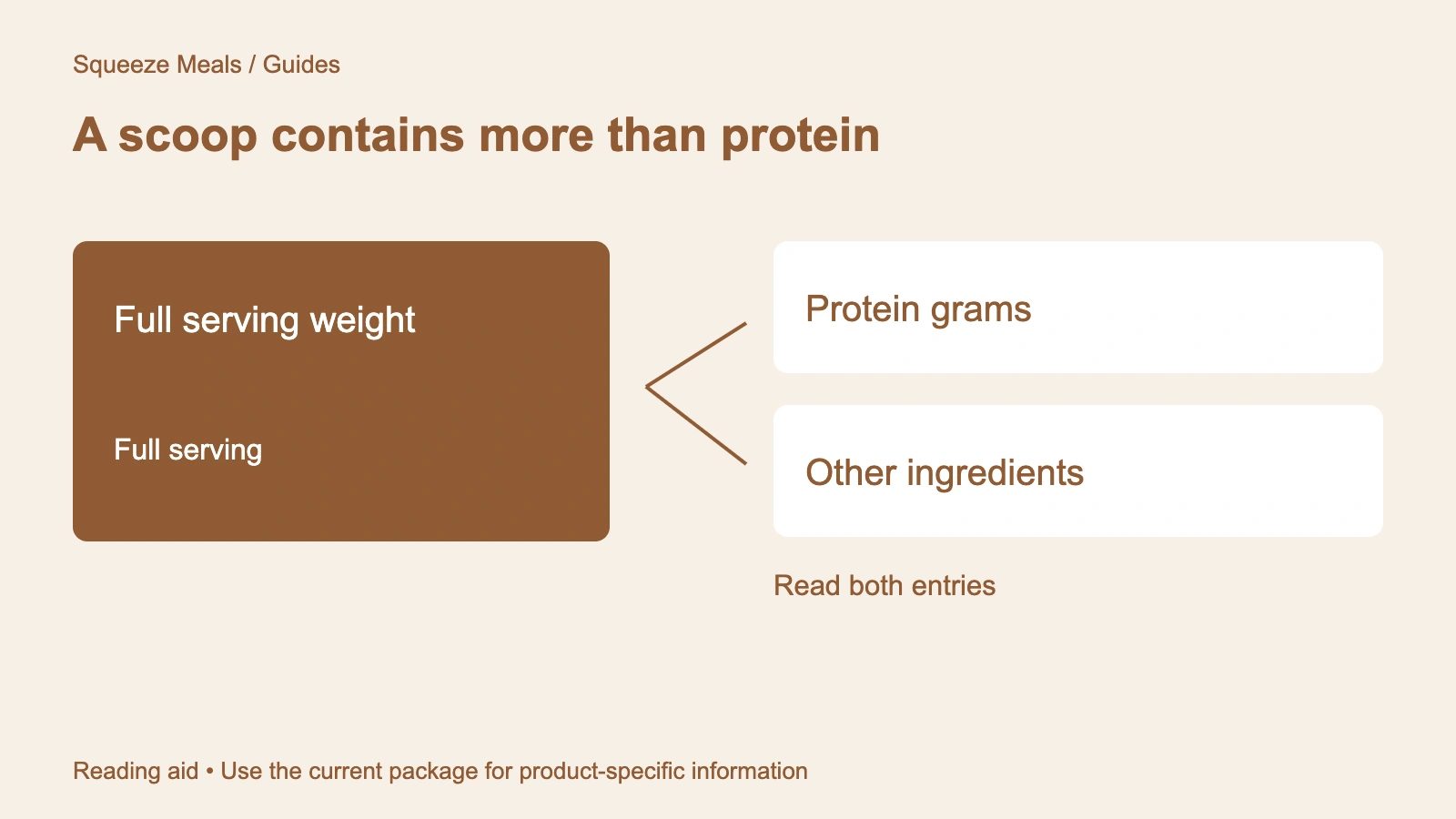
A scoop's weight and its protein content are different entries. Read the protein grams for the full labeled serving, then find the protein source in the ingredients. For a product sold as a recovery formula, first check whether it contains protein at all.
Start with the serving, then read the protein line
A scoop of powder has a total weight. Only part of that weight may be protein. Put the serving size and the protein amount next to each other before comparing two containers.
For a purely illustrative label, a 32-gram serving might contain 24 grams of protein. The remaining weight belongs to the rest of the formula. The example is fictional. It illustrates the two label fields without assigning either quantity to a Squeeze Meals product or recommending an intake.
Copy the number of scoops or packets that makes up one serving. Check whether the panel describes the powder alone or a prepared drink. Adding milk changes what is in your glass, so use the same preparation basis when comparing products. Keep the correct scoop with its container.
If the panel is hard to read online, get a clear image of the current package before buying. Our Supplement Facts label guide explains how serving size and ingredient amounts fit together.
A comparison sheet for two products
Use the package for each exact flavor and size. Write "not disclosed" when the label or manufacturer has not supplied a field.
| Comparison field | What to record | A useful follow-up |
|---|---|---|
| Serving size | Grams of powder and the stated scoop or packet count | Is this the powder alone or prepared with another ingredient? |
| Protein | Grams per labeled serving | Are both products being compared on the same basis? |
| Protein source | The named source or sources in the ingredients | Does it fit your food preferences and restrictions? |
| Amino-acid information | Any disclosed amounts and the basis used | Is an amount per serving or per 100 grams? |
| Rest of the formula | Sweeteners, flavorings, and additional dietary ingredients | Does another product you use contain the same added ingredient? |
| Allergen information | The current package wording | Is anything unclear enough to ask the manufacturer? |
| Certification | Exact program, product listing, and any applicable lot details | Does the directory match this product? |
| Cost | Current price and labeled servings per container | Are shipping, discounts, and serving sizes comparable? |
Protein source and amino-acid context
NIH's Office of Dietary Supplements explains that protein supplies amino acids, including essential amino acids that must come from the diet. Whey is a milk protein that supplies all essential amino acids. For plant-based products, identify the actual sources and any combination used. A plant-based description alone does not tell you the amounts in a particular formula. NIH ODS consumer fact sheet
The phrase "complete protein" refers to essential amino-acid coverage, so you still need the protein-grams line to learn how much the labeled serving supplies. If a manufacturer supplies an amino-acid profile, check its units before comparing leucine or another amino acid across products. A profile per 100 grams cannot be copied directly into a column for amounts per serving.
BCAAs are three essential amino acids: leucine, isoleucine, and valine. A BCAA product therefore answers a different comparison question from a protein powder. NIH ODS reports inconsistent evidence that added BCAAs improve muscle protein synthesis beyond sufficient high-quality dietary protein. Ask what the extra product would add. NIH ODS professional fact sheet
Read the ingredients beyond protein
A flavored powder may contain sweeteners and flavorings alongside its protein source. FDA identifies these among the kinds of other ingredients used in dietary supplements. Record anything that affects whether you can use the product, and look separately for added vitamins, minerals, or other dietary ingredients. FDA questions and answers
"Recovery" on the front of a package is not enough information for a comparison. Open the ingredient panel. If a blend gives only one combined weight, mark the individual amounts as undisclosed rather than trying to divide that weight among its ingredients.
Flavor is worth checking at this stage. Different flavors can have different ingredient lists. If you have a food allergy, use the current allergen information and resolve uncertainty with the manufacturer before purchasing. Do not infer suitability from an image of a scoop or the word "isolate."
What certification can establish
NSF says its Certified for Sport program checks label contents, specified contaminants, and prohibited substances, with manufacturing oversight. Search the official certified-product directory for the exact product and review the listing details. Use the logo as a search prompt. NSF program explanation
Keep certification and expected results in separate columns. Certification does not calculate your protein needs or promise that a product will improve your training. We have not verified a certification listing for the Squeeze Meals examples below and do not present them as certified products.
Read the two catalog listings
Whey Protein Isolate - Vanilla and Amino Complex - Berry are current Squeeze Meals catalog entries. They are useful starting points for two different label checks.
For the whey product, request or read the current package panel and record protein grams, serving size, and the full ingredient list. For the amino-acid product, record which amino acids are disclosed and their labeled amounts, keeping a blend's total weight separate from any declaration of dietary protein.
The catalog pages are shortlist pages. They do not provide enough panel detail to establish a complete serving-by-serving comparison here. We have therefore left product-specific protein quantities, amino-acid doses, and certification claims out of this guide. Browse protein powders or amino-acid products to choose the labels you want to compare.
Cost per serving needs a consistent denominator
Divide the current container price by the number of labeled servings. Record any discount. To make the comparison usable later, add the date and handle shipping on the same basis for both products.
Cost per gram of protein can be a second comparison for protein powders: divide the container price by the total labeled grams of protein in that container. This arithmetic does not establish quality or suitability. It is also not a useful shortcut for comparing a protein powder with a formula containing selected amino acids or several recovery ingredients.
Avoid estimating servings from the container's appearance. A larger tub may use a larger labeled serving.
What the label cannot decide for you
NIH ODS notes that many athletes can meet their protein needs through food, with supplements used when needed. A package cannot determine whether your usual meals already meet your needs. This guide does not set a daily protein target, supplement dose, or workout schedule. NIH ODS consumer fact sheet
Bring the complete label and your current supplement list to a clinician or pharmacist if you take medication, have a health condition, are pregnant or nursing, or have planned testing or surgery. NIH ODS discusses interactions and other circumstances that warrant professional advice. NIH ODS supplement overview
Useful questions to take with you:
- Does this formula fit my health history and current medicines?
- Should I review my food intake before adding a protein product?
- Do any added ingredients need special consideration before my test or procedure?
- Is there a reason to avoid combining this with the supplements I already use?
Open two products in protein powders or sports performance and collect their current labels to fill in the comparison sheet. Missing a field? Ask for a readable panel before choosing.
Sources
Sources checked September 27, 2026. Catalog examples checked on the same date.
- NIH Office of Dietary Supplements: Exercise and Athletic Performance, consumer fact sheet — protein sources and food-first context.
- NIH Office of Dietary Supplements: Exercise and Athletic Performance, health professional fact sheet — essential amino acids and BCAA evidence limitations.
- NIH Office of Dietary Supplements: What You Need to Know — safety discussions and professional advice.
- FDA: Questions and Answers on Dietary Supplements — ingredient categories and consultation guidance.
- NSF: What Our Mark Means — certification scope.
This guide is educational and does not replace current product labels or advice from a qualified health-care professional.