Capsule, Powder, Liquid or Gummy?
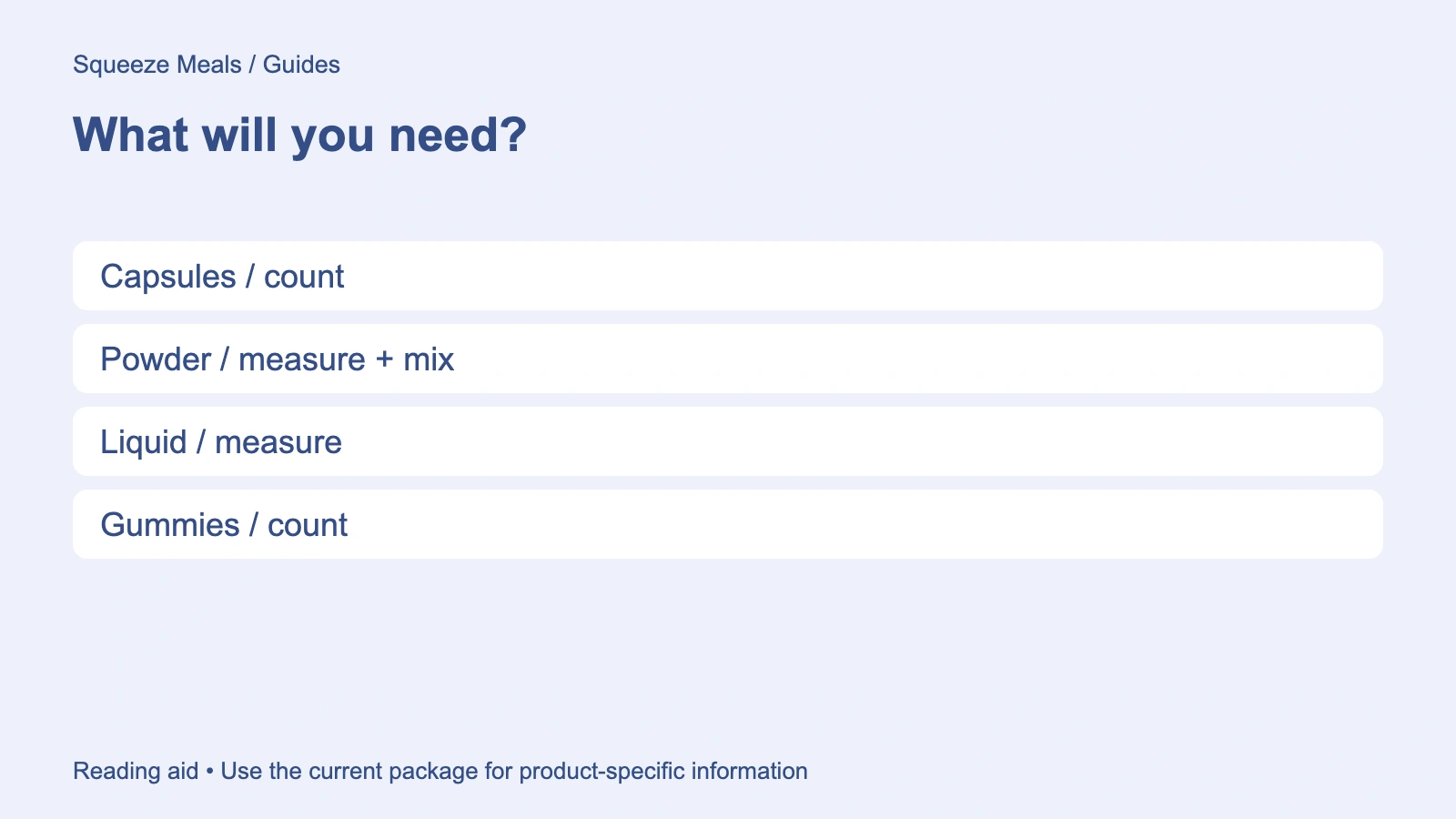
Powders need measuring and mixing, while liquids require the measure specified on their label. Capsules and gummies have serving counts to check. After comparing the formulas, use the table below to decide which practical differences matter for your day.
Compare the product before the package
FDA recognizes all four of these formats and also includes tablets and softgels, along with bars, among the forms in which dietary supplements may be sold. That list describes how a product is delivered. It does not rank the formats.
Start with the job you want the product to do, then compare products with the same dietary ingredient and intended use. A magnesium capsule and a creatine powder differ in more than their containers. Putting them in a capsule-versus-powder contest would hide the larger difference: they are different products.
Once two options belong in the same comparison, the format becomes useful. It tells you how many units make a serving, whether you need water or a measuring tool, what you must carry, and which non-dietary ingredients appear on the label.
What the label can answer
The Supplement Facts panel gives you a common starting point across formats. FDA requires it to identify the serving size, servings per container, dietary ingredients, and the amount of each declared dietary ingredient per serving, subject to specific labeling rules. Ingredients outside that panel appear in the separate Other Ingredients list.
For each product, copy these details before comparing:
- the labeled serving size, including capsules, scoops, drops, milliliters, or gummies;
- the number of servings in the package;
- the amount of the dietary ingredient per serving and its unit;
- the Other Ingredients list;
- directions and warnings, plus storage instructions;
- the current package price divided by servings per container.
The order matters. A bottle labeled "120 capsules" may contain 60 two-capsule servings. A powder tub can look larger while containing fewer labeled servings than a smaller package. Counting capsules, gummies, ounces, or bottles without checking the serving basis creates a false price comparison.
If you need a refresher on panel structure, use the Supplement Facts label guide before making the format comparison.
What the label cannot answer
A label declares the ingredients and amounts per serving. It cannot establish universal absorption advantages for a format or determine whether a particular product belongs in your routine.
Absorption depends on the ingredient and its chemical form. The finished formulation, directions for use, and the person taking it matter too. A statement such as "liquids absorb faster" or "powders work better" is too broad to use as a buying rule. Look for evidence tied to the specific ingredient and formulation. When that evidence is absent, leave the question open.
FDA does not approve dietary supplements for safety and effectiveness before sale. Packaging tells you nothing about that approval, and a convenient format does not establish product quality.
How the formats differ in daily use
Capsules and tablets
Capsules and tablets divide a serving into fixed units. That makes the count visible: the directions might call for one unit, two, or several. The practical question is whether the full labeled serving fits the routine, not how small the bottle looks.
Read the Other Ingredients list for capsule or tablet materials and binders. Coatings or color additives may appear there too. If swallowing is difficult, ask a pharmacist whether the specific product has an appropriate alternative. Do not open, crush, or split it unless the label or a qualified professional says that is suitable for that product.
Powders
Powders usually add two steps: measuring and mixing. Check whether the serving is defined by weight, a scoop, or both. A scoop is a tool supplied with the package; the declared amount on the current label is the comparison number.
Powder can suit a routine that already includes water or another drink. It can be less convenient when you have nowhere to mix it or must carry the full tub. Single-serve packets change that tradeoff by pre-portioning the powder, though you still need to check the amount and number of packets per package.
Close the container as directed and follow its storage statement. Instructions about moisture and heat are product-specific. The same is true for handling, so the package wins over a general rule.
Liquids
Liquid labels may state a serving in drops, a dropper measure, or milliliters. Copy the exact unit. "One dropper" and "1 mL" should not be treated as interchangeable unless the package defines them that way.
Liquids avoid swallowing a capsule, but they still require consistent measurement. Check whether the measuring device is included and whether the directions say to shake, refrigerate, or use the product within a stated period. Those instructions vary by product.
Gummies
Gummies divide a serving into a count of pieces. Read the serving size before comparing the amount of a nutrient with a capsule or liquid. One gummy on the front of a package does not necessarily represent one labeled serving.
The Other Ingredients list is especially useful here because it identifies sweeteners, flavors, colors, gelling agents, and other declared components outside the Supplement Facts panel. Storage deserves a direct look too. Follow the temperature and handling directions printed on the package.
Softgels
Softgels are another fixed-unit format. They often hold liquid or oil-based contents inside the shell, but that fact does not make every softgel comparable. Check the dietary ingredient amount, serving count, shell ingredients, and storage directions just as you would for a capsule.
A side-by-side format checklist
| Check | Capsules or tablets | Powders or packets | Liquids | Gummies |
|---|---|---|---|---|
| Labeled serving | Units per serving | Scoop, packet, or weight | Drops or volume | Pieces per serving |
| Setup | Swallow the full labeled unit count | Measure or open packet; mix if directed | Measure with the stated device | Count the full labeled serving |
| Carrying | Bottle or organizer that preserves the label | Tub, scoop, or individual packets | Bottle plus leak protection | Original package and storage protection |
| Other Ingredients | Shells, coatings, binders, colors | Flavors, sweeteners, flow agents | Carrier ingredients, flavors, preservatives | Sweeteners, flavors, colors, gelling agents |
| Storage check | Read heat and moisture directions | Keep the closure and scoop as directed | Check temperature and after-opening instructions | Check temperature and handling directions |
| Price comparison | Price ÷ labeled servings | Price ÷ labeled servings | Price ÷ labeled servings | Price ÷ labeled servings |
Consider where you will use it. Measuring powder in a kitchen can be manageable while doing the same on a trip needs equipment, and someone who struggles to swallow capsules may prefer to discuss another format.
Two catalog examples
Creatine - Travel Packs shows how packaging can change the routine without changing the need to read the label. The catalog identifies it as a powder. Compare the current packet serving and dietary ingredient amount with any tub you are considering. Add servings per box and directions to the same notes. Then calculate the price per serving. The packet may be easier to carry, while a tub may use less individual packaging. The label supplies the numbers for a fair comparison.
Vitamin D + K2 Liquid gives you a liquid-format example. Check the current serving unit and amount per serving. Note the included measuring method and Other Ingredients, then read the directions and storage statement. A capsule product with similar front-label wording may use a different serving basis or ingredient form, so match those details before comparing price or convenience.
These examples demonstrate the process. They are not recommendations. Current prices and formulas can change, as can directions or availability. The supplement catalog lets you filter the current selection and open the relevant product pages.
When a clinician or pharmacist should join the comparison
FDA advises talking with a doctor, pharmacist, or other health-care professional before deciding to use a dietary supplement. Bring the full label or clear photos rather than relying on the front panel.
Ask for help when medication, pregnancy, breastfeeding, a medical condition, lab testing or planned surgery is relevant. Bring unclear directions and any overlapping ingredients to the same discussion. Ask how to follow the directions for the particular format you are considering.
Filter the supplement catalog by format, open two current product pages, and copy their serving instructions into the checklist. Compare the products on the same serving basis before price or package preference enters the decision.
Sources
Sources checked September 19, 2026:
This guide is educational and does not replace current product labels or advice from a qualified health-care professional.