A Supplement Shortlist You Can Take Shopping
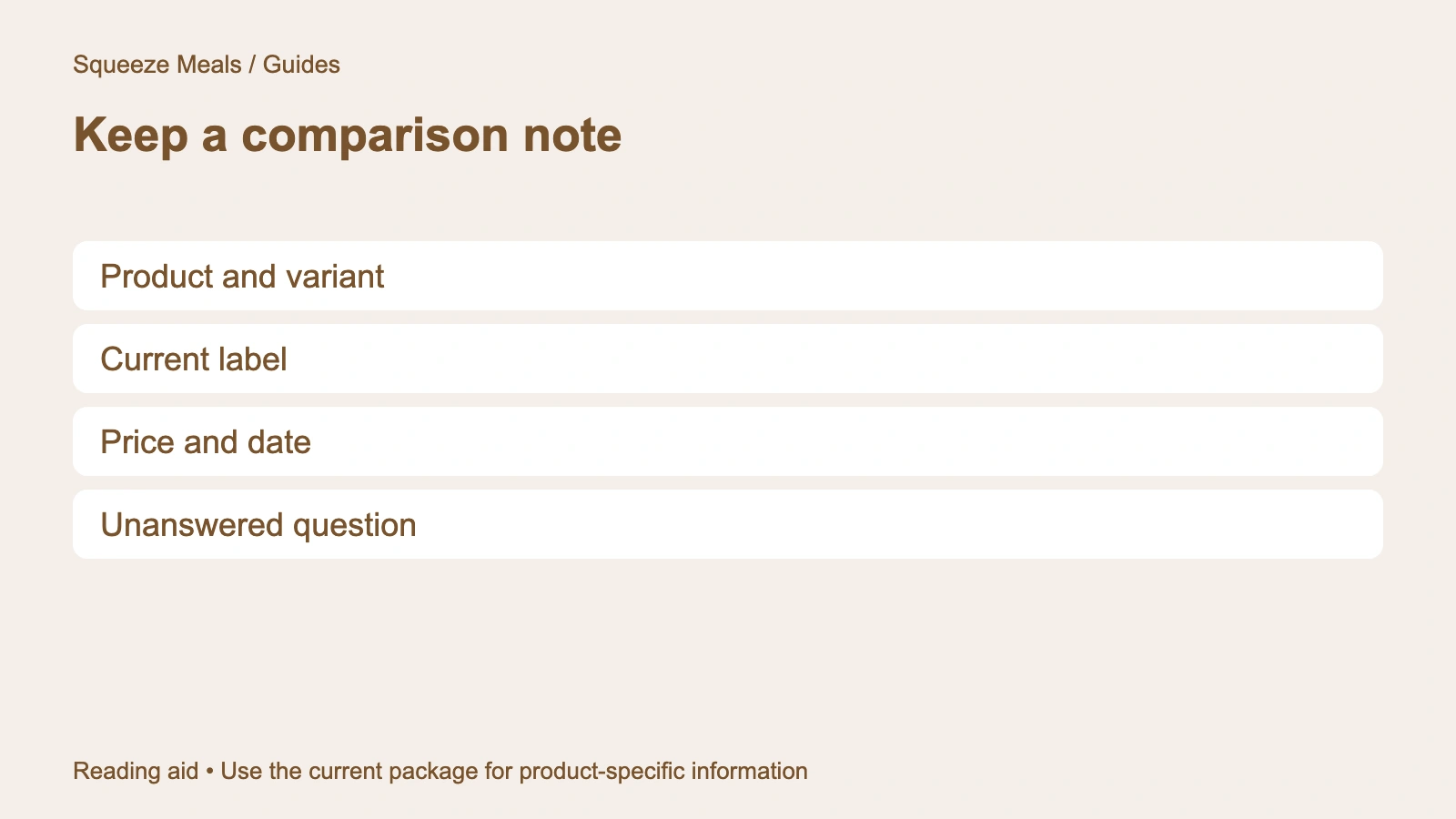
Save two candidate products and their complete labels in one note. Keep the current price beside each label, and leave space for a question you still need answered. The worksheet below gives you a record you can return to when the offer or packaging changes.
Give each candidate a job
Write down the purchase you are comparing. “Compare portable creatine products” narrows the task, while “build a complete wellness routine” leaves almost every catalog item in contention.
You can also write down a question: "Do I need a supplement at all?" Leave room for that answer. FDA recommends discussing supplements with a health-care professional before buying or taking them. A shopping category cannot determine personal suitability.
Two or three saved products are a manageable comparison set, not a recommended number to take. Keep unrelated goals on separate pages. Someone browsing the sleep category and the sports-performance category is looking at different sets of questions, even when both categories use the word "recovery."
Make an inventory before adding anything
NIH's Office of Dietary Supplements recommends keeping a record of supplements and medicines, including the amount taken, frequency, and reason for use. Use the exact product names. Add clear photos of the full labels so a pharmacist can check the ingredients behind those names.
Include occasional products. A powder used only on gym days belongs in the record alongside a daily capsule. Note fortified drinks too, since ODS points out that added nutrients in foods and beverages can contribute to your intake.
Now compare the ingredient lists with your candidates. If a nutrient appears twice, mark the overlap and copy the units exactly. That is a question to review, not a reason to calculate a personal dose from this guide. Leave medicines unchanged while gathering information.
What the label can answer
Check serving size and servings per container before reading Other Ingredients, directions and warnings. The Supplement Facts guide shows where to find them.
Record what is actually visible. If an online photo is too blurry to read, write "label needed" and request a current image from the seller or manufacturer. A blank cell should stay blank until you have the information.
For a price comparison, divide the current package price by labeled servings per container. Here is illustrative arithmetic, unrelated to current Squeeze Meals prices: a $24 package with 30 servings costs $0.80 per labeled serving. A $30 package with 60 servings costs $0.50. Those figures only help once you have checked whether the ingredients and serving amounts are comparable. A larger package can still be the wrong candidate for your question.
Copy this comparison worksheet
Use one column per candidate. Keep a link to the current label beside each product name.
| Field | Candidate A | Candidate B | What to check |
|---|---|---|---|
| Product and label date | Record name and date viewed | Record name and date viewed | Are you comparing the current versions? |
| Reason for considering it | Write your question | Write your question | Do both belong in this comparison? |
| Dietary ingredient and form | Copy from label | Copy from label | Similar names can hide different formulations |
| Amount per labeled serving | Copy number and unit | Copy number and unit | Keep mg, mcg, and other units explicit |
| Serving size | Copy units or measure | Copy units or measure | Bottle count is different from serving count |
| Other Ingredients and warnings | Save full text or photo | Save full text or photo | Mark anything needing clarification |
| Overlap with your inventory | List repeated ingredients | List repeated ingredients | Bring overlaps to a qualified professional |
| Routine fit | Note measuring and storage | Note measuring and storage | Can you follow the actual directions? |
| Cost per labeled serving | Price divided by servings | Price divided by servings | Recheck current price before purchase |
| Open question | Write the missing answer | Write the missing answer | Keep unresolved candidates on hold |
What the label cannot settle
A Supplement Facts panel declares product information. It does not establish FDA approval: FDA does not approve dietary supplements for safety and effectiveness before sale. The panel also cannot determine your personal need.
Separate the label data from the advertising. FTC guidance requires health-related advertising claims to have appropriate scientific support. If a product promises a benefit, look for the evidence behind that specific claim. A confident headline provides no substitute for it.
NCCIH cautions that products sold to consumers can differ from study preparations. Check what formulation and population a paper actually examined before applying its findings to a bottle with the same ingredient name.
Quality testing has a different purpose. ODS explains that independent quality seals do not guarantee safety or effectiveness. If a candidate displays one, check the exact product in the certifier's own directory and read what the program tests. Keep that finding separate from the question of whether the supplement is appropriate for you.
Try the worksheet on current catalog pages
The Squeeze Meals catalog lists Creatine - Travel Packs. Use that page to practice the packaging questions: what counts as a serving, how many servings the box contains, and what preparation the directions require. Save the current label before comparing it with another creatine product. The packet format alone cannot answer those questions.
For Vitamin D + K2 Liquid, look for both nutrients in your existing-product inventory. Copy each amount from the current label together with the precise liquid serving measure.
These examples identify fields to inspect. They do not recommend either product or establish availability, suitability, or a dose. For a closer look at measuring and carrying different products, see the supplement formats guide.
Bring unresolved questions to a clinician or pharmacist
Tell your care team about medicines, planned tests or surgery, which FDA identifies as relevant to supplement use. Also mention pregnancy or breastfeeding. NCCIH notes that many supplements have limited testing in those circumstances.
Bring the inventory and candidate labels. Useful questions include:
- Does any ingredient conflict with a medicine or another product I already use?
- Is this supplement relevant to my stated goal, or should we investigate the concern first?
- Do my planned lab tests or procedure change the decision?
- Which warning or missing label detail needs an answer before I buy?
Record who you asked and what they said about the exact product. Keep a candidate on hold if its identity or label remains unclear.
Start with two current labels from the supplement catalog and complete one comparison column before adding another candidate. Take unresolved safety or suitability questions to a clinician or pharmacist.
Sources
Sources checked September 20, 2026:
- FDA: FDA 101, Dietary Supplements — label information, premarket approval, and consultation about medicines, tests, and surgery.
- NIH Office of Dietary Supplements: Dietary Supplements, What You Need to Know — supplement and medicine records, overlapping intake, and the limits of quality seals.
- NCCIH: Using Dietary Supplements Wisely — differences between studied and marketed products and pregnancy or breastfeeding evidence gaps.
- FTC: Health Products Compliance Guidance — scientific support for advertising claims and the limits of testimonials.
This guide is educational and does not replace current product labels or advice from a qualified health-care professional.