Packing Supplements for a Trip
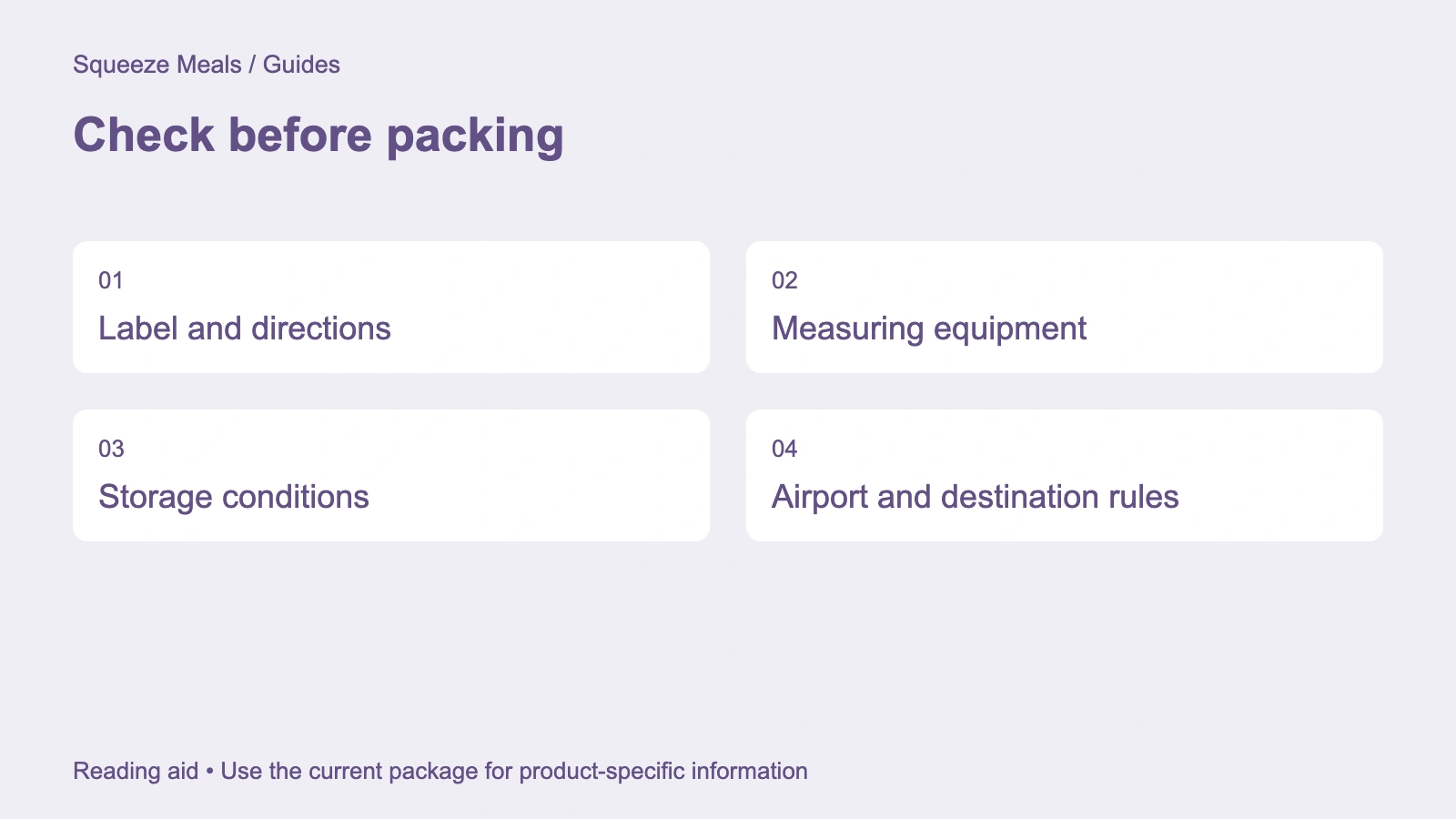
Pack the equipment as well as the supplement. A powder may need a scoop and mixing bottle, while a liquid needs a suitable container and its measuring device. Check storage directions before moving anything into an organizer. For a flight, look up the rules for the form you are carrying.
Start with the serving you already use
Check the packet’s full formula. A smaller package may contain different amounts or added ingredients, so record the ingredient amounts with the serving measure before replacing the product you use at home.
The FDA's supplement guidance explains that a Supplement Facts label includes serving size, servings per container, and dietary ingredient amounts. Our label-reading guide shows where those fields sit. For a travel comparison, add the physical package count to your notes so that a box of packets is not mistaken for the same number of servings.
Consider an illustrative packing calculation: a carton holds ten packets and its label defines a serving as two packets. That carton contains five labeled servings. This is invented arithmetic, not a Squeeze Meals product specification or advice about how much to take.
Keep your established instructions beside the new label. A change in packaging is a reason to check the formula again, especially if the new version adds ingredients.
Compare the whole packing setup
The container is only part of the space a supplement takes up. Powder may also require a cup, water, and a way to measure it. A liquid's measuring device needs room too. Put those items beside the package before deciding which format fits your bag.
| Format | What to check on the label | What to account for in your bag |
|---|---|---|
| Sealed powder packets | Packets per serving, contents of each packet, mixing directions | Number of packets, water and mixing container, discarded wrappers |
| Capsules or tablets | Units per serving and the full ingredient list | Container size and a way to keep the product identifiable |
| Liquid | Serving volume, measuring directions, storage after opening | Bottle capacity, secure closure and measuring device |
| Powder in a tub | Serving measure and preparation instructions | Tub, measuring tool, mixing container and access for screening |
Single-serving packaging can remove the need to portion powder yourself when the packet matches the labeled serving. It doesn't remove the need to read directions. Some packets also rely on an outer carton for information, so save that panel before discarding the box.
For a broader comparison at home, see our guide to supplement formats. On a trip, the practical question is whether you can follow the particular product's instructions with the space and equipment available.
Read storage directions before choosing an organizer
Check storage before deciding what to pack. Read temperature instructions and any requirements after opening, and ask the manufacturer to clarify missing directions.
A hotel room without the storage a product requires should affect your packing decision. The word "travel" on a listing does not establish that it tolerates heat or can be kept without refrigeration. Check the exact package you intend to buy.
Ask whether the product needs its original container before using an organizer. Keep its label and available lot details accessible, then separately verify the documentation required for your route.
Check TSA rules for the form you are carrying
The following describes the TSA pages checked September 26, 2026. Recheck them before departure. These are U.S. checkpoint rules, and this guide does not verify admission or import requirements for any foreign destination.
Liquid containers
Under the TSA liquids, aerosols, and gels rule, the ordinary carry-on allowance uses containers of 3.4 ounces (100 milliliters) or less per item, placed in a quart-sized bag. TSA directs larger containers to checked baggage. The container's capacity matters even when it is partly empty.
The rule page lists exemptions, including medications. Don't assume that a liquid supplement qualifies for an exemption because you take it regularly. Check TSA's guidance for your circumstances before packing it that way. Liquids that trigger an alarm require additional screening.
Powders
TSA's protein or energy powders entry lists these powders as allowed in carry-on and checked bags. It says powder-like substances greater than 12 oz. / 350 mL must go in a separate bin for X-ray screening. Additional checks may be needed, and containers may be opened.
TSA encourages placing non-essential powders above that threshold in checked bags. Preserve its stated units. An ingredient quantity in milligrams is a different measure, and the words “travel packs” do not establish checkpoint acceptance.
Vitamins
TSA lists vitamins as allowed in carry-on and checked bags, with liquid vitamins also subject to the liquids guidance. The checkpoint officer makes the final decision. TSA vitamins entry
For an international itinerary, consult the destination's official customs or health authority about the actual ingredients and quantity you plan to carry. Ask your airline about its baggage requirements as a separate check. No destination-specific allowance is established here.
Two catalog examples to examine
Creatine - Travel Packs is listed in our catalog as a powder format. Use its current label to check how many packets make a serving and how preparation compares with your existing product. Don't infer the contents or mixing volume from the listing name.
For Magnesium Bisglycinate - Travel Packs, read the declared magnesium amount with the serving basis and any added ingredients. Request a readable panel if necessary.
These are packing comparisons. We have not verified the products’ lots, certifications, shelf lives or airport acceptance.
Questions to take to a clinician or pharmacist
Bring the complete labels if you are changing products for a trip. Ask whether the ingredients fit your current medicines and whether a different serving measure changes your existing instructions. Mention pregnancy or a health condition when relevant to your care.
FDA notes that supplements can interact with medicines, interfere with laboratory tests, or affect surgery. Discuss upcoming testing or procedures with your care team before changing your routine. A smaller package provides no evidence of personal suitability, and this shopping guide gives no dosing schedule or treatment recommendation.
Save two current labels from the supplement catalog with the instructions you already follow. Resolve storage and the travel requirements for your route before ordering.
Sources
Sources checked September 26, 2026:
- Transportation Security Administration: Liquids, Aerosols, and Gels Rule. Standard carry-on container allowance, bag size, screening and links to exemptions.
- Transportation Security Administration: Protein or Energy Powders. Carry-on and checked-bag status, powder screening threshold and officer discretion.
- Transportation Security Administration: Vitamins. Bag allowances and final checkpoint decision.
- FDA: FDA 101, Dietary Supplements. Supplement label fields and cautions concerning medicines, testing and surgery.
This guide is educational and does not replace current product labels or advice from a qualified health-care professional.