Vitamin D: Converting mcg and IU
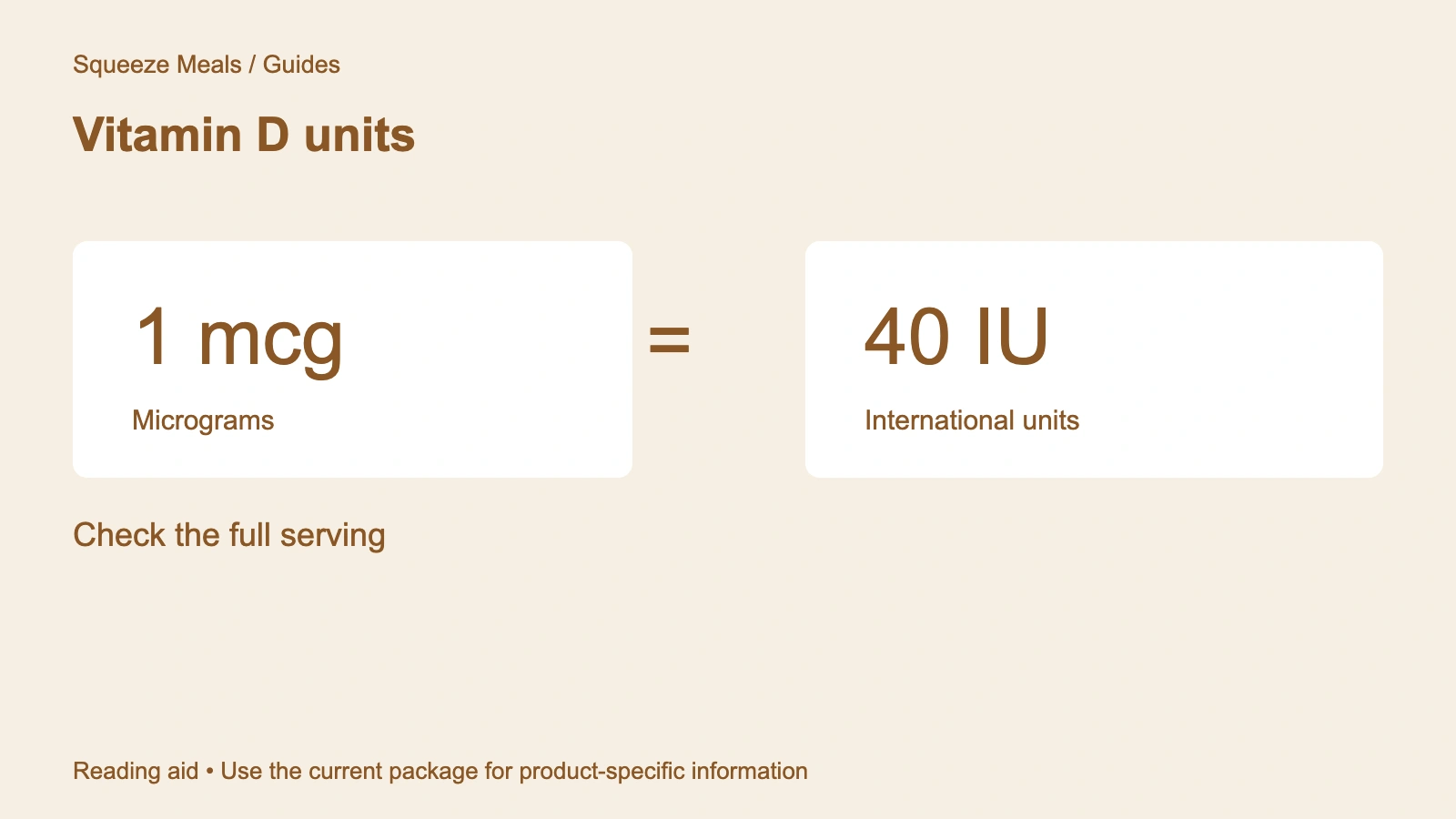
For vitamin D, 1 microgram equals 40 IU. Convert the units before comparing two amounts, and keep the serving size attached. A liquid label may describe one drop or a measured volume, so the bottle's dropper is not enough to identify a serving.
Find D2 or D3 on the panel
Look beside the vitamin D entry for its ingredient form. The names you may see are ergocalciferol for D2 and cholecalciferol for D3. NIH's Office of Dietary Supplements identifies both in its vitamin D consumer fact sheet.
Copy the wording exactly. A front label that says only "vitamin D" leaves this comparison unfinished, so open the Supplement Facts image before assuming the form. If that image is unreadable, ask the retailer for a current panel.
Form and amount are separate fields. Finding the same form in two products doesn't establish that their serving sizes or strengths match. Nor does the name establish the ingredient's animal or plant source. Check an explicit source statement if that matters to your purchase.
Put mcg and IU into the same column
For vitamin D, 1 microgram equals 40 International Units, according to the NIH ODS professional fact sheet. Labels abbreviate micrograms as mcg and International Units as IU. Multiply mcg by 40 to get IU, or divide IU by 40 to get mcg.
These are unit conversions, with no intake recommendation attached:
| Vitamin D amount in mcg | Equivalent amount in IU |
|---|---|
| 10 mcg | 400 IU |
| 25 mcg | 1,000 IU |
| 50 mcg | 2,000 IU |
A panel showing 25 mcg and another showing 1,000 IU describe the same vitamin D amount if both figures refer to the serving being compared. Keep the serving size beside the calculation. Otherwise, a correct conversion can still produce a misleading comparison between one capsule and several drops.
This conversion applies to vitamin D. Don't reuse the factor of 40 for another nutrient simply because its label also uses IU. Our Supplement Facts guide explains how to keep amounts attached to their units.
Check liquid measurements before comparing formats
Read the printed serving unit closely. A drop, a dropperful, and a milliliter describe different measurements, and a full dropper is not a substitute for a stated number of drops. Follow the product's own directions and measuring device.
Suppose an illustrative label gives its vitamin D amount per five drops. That amount belongs to the full labeled serving. Record "five drops" in your notes so it cannot later be mistaken for the amount in one drop. This example does not describe either linked catalog product or suggest how much to take.
For capsules, record the number in a serving and the servings per container. Compare practical details too: whether you can comfortably use the format, how it must be stored, and whether the directions are clear enough to follow. A liquid's appearance provides no reliable clue to its concentration.
If a label states a volume but the supplied device uses different markings, ask the manufacturer or pharmacist how to measure it correctly before using the product. Avoid estimating from a photograph of a dropper.
Read %DV alongside the actual amount
The FDA's Daily Value reference lists 20 mcg for vitamin D in its general reference table. The percentage on a label expresses a serving's contribution to the applicable Daily Value. It is a reference for reading the label, not a personalized target.
Keep the mcg amount in your comparison even when %DV is prominent. You can then discuss the actual quantity with a clinician without trying to interpret a large percentage from memory. Check that the label is intended for the age or life-stage group you are shopping for.
A worksheet for two current labels
Save both panel images and note the date. Fill this table before deciding that two products are interchangeable.
| Detail to record | Product A | Product B |
|---|---|---|
| Exact product and label date | Copy both | Copy both |
| Vitamin D form | D2, D3, or not stated | D2, D3, or not stated |
| Labeled serving size | Capsule count, drops, or volume | Capsule count, drops, or volume |
| Vitamin D per serving | Amount in mcg and equivalent IU | Amount in mcg and equivalent IU |
| %DV and intended audience | Copy from the panel | Copy from the panel |
| Other nutrients | Names and declared amounts | Names and declared amounts |
| Other ingredients and source statements | Record relevant wording | Record relevant wording |
| Directions and storage | Copy the instructions | Copy the instructions |
| Servings per container | Labeled count | Labeled count |
| Open questions | Unclear measurements or missing information | Unclear measurements or missing information |
Write "not stated" when a field is absent. A blank field should not silently become a zero. For a price comparison, divide the current package price by labeled servings only after you have checked the formula and offer terms. This guide does not assign current prices to the products below.
Higher strengths need a personal review
A larger number on the package is a reason to examine the amount carefully. NIH ODS warns that excessive vitamin D intake can be harmful and that vitamin D can interact with some medicines. Its consumer guidance also explains that clinicians sometimes use specific regimens for a diagnosed deficiency.
The label cannot establish whether you have a deficiency, whether a test is appropriate, or how long you should use a particular strength. Bring those questions to the professional managing your care. Don't change a prescribed regimen based on a shopping comparison.
Include vitamin D from other supplements in that discussion. A multivitamin may already contain it, so save that panel as well. The multivitamin comparison worksheet can help you identify repeated ingredients without assuming that overlap proves excessive intake.
Compare the catalog listings without inferring their formulas
Vitamin D + K2 Liquid is a useful starting point for checking a liquid serving measure and an additional nutrient. Read the current panel for the amounts of each ingredient. The combination name alone does not establish that you need K2 or that the product suits your medications.
The Vitamin D-5,000 listing gives you a different product to investigate. Confirm the unit, serving directions, and full panel instead of treating the number in its name as an intake instruction. This article does not independently verify a certification or prescribe that strength.
The illustration shows generic packaging. It is not a photograph of either product, and the guide does not assert their current formula, stock, or price.
Questions for your clinician or pharmacist
Take the panels and a complete medication list. The FDA's supplement guidance notes that supplements can affect medicines, laboratory tests, and surgery. Mention pregnancy, breastfeeding, or a relevant condition when discussing suitability.
- What information would help decide whether I need supplemental vitamin D?
- Does vitamin D in my existing supplements affect this choice?
- How should I interpret this higher-strength label in relation to my care plan?
- Do the added ingredients or liquid measuring instructions need clarification?
Keep any agreed intake plan separate from the comparison table so packaging arithmetic cannot be mistaken for medical instructions.
Open the vitamin D listings in the immune supplements category and save two current panels. Convert their vitamin D amounts to the same unit, preserve each serving measure, and resolve any intake question with your clinician before buying.
Sources
Sources checked September 25, 2026:
- NIH Office of Dietary Supplements: Vitamin D, Consumer Fact Sheet. Form names, excess-intake cautions, and medication considerations.
- NIH Office of Dietary Supplements: Vitamin D, Health Professional Fact Sheet. The vitamin D mcg-to-IU conversion.
- FDA: Daily Value on the Nutrition and Supplement Facts Labels. Daily Values and label units.
- FDA: FDA 101, Dietary Supplements. Supplement interactions and the role of professional advice.
This guide is educational and does not replace current product labels or advice from a qualified health-care professional.